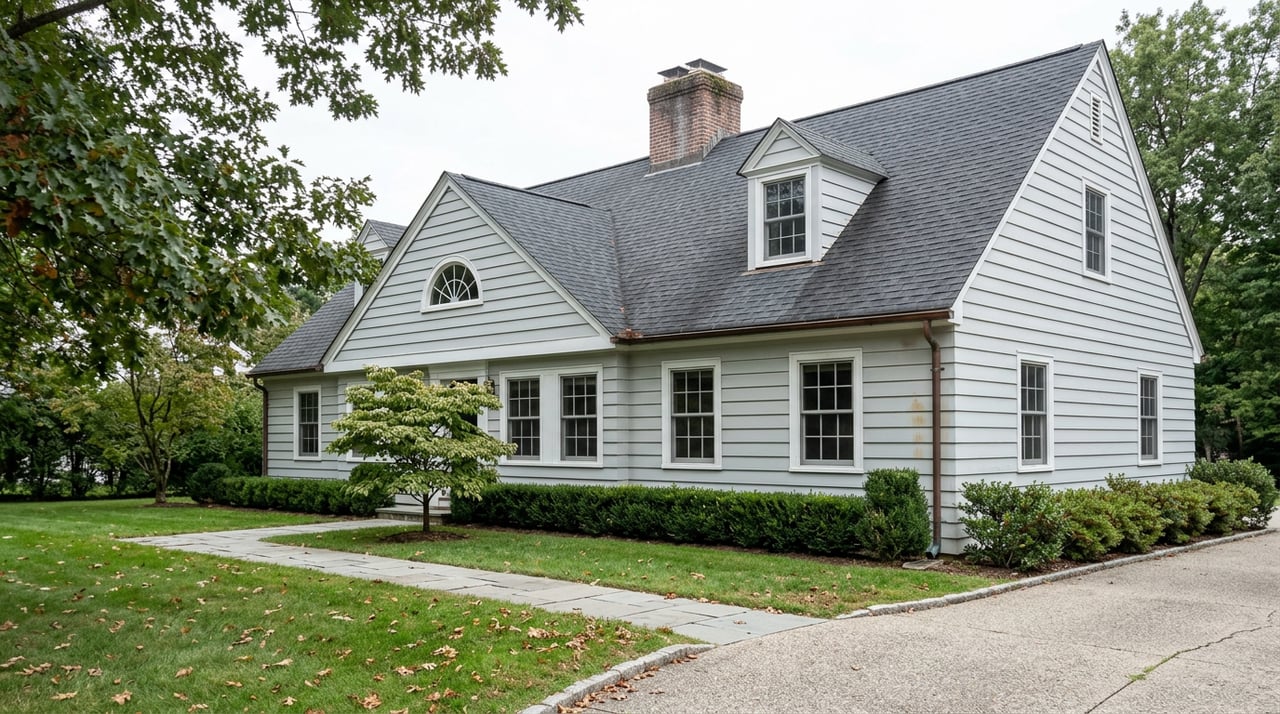
If two similar colonials list for the same price this fall, one with a Pennington Borough address and one a half mile away with a Hopewell Township address, will they cost the same to own ten years from now? The listing price alone won't tell you; the school tax rate and the property's assessed value both affect its school-tax cost.
Both sit inside the Hopewell Valley Regional School District, which is unusual in New Jersey. Most regional districts only cover middle and high school, with each town running its own elementary system. Hopewell Valley runs one unified budget, pre-K through 12th grade, across three separate municipalities: Hopewell Township, Hopewell Borough, and Pennington Borough. According to MercerMe, under state law, that single levy gets divided among the three towns based on each one's share of total equalized property value, not on how many children each town actually sends to school. A town's tax bill can rise even when its own spending, enrollment, and home values stay flat, simply because its share of the region's total property value shifted.
That mechanic has been quietly reshaping who pays what in Hopewell Valley for years. The rate history makes the shift visible in a way a single year's snapshot never could.
Watch the Rate, Not the Sticker Price
Look at how the three towns' school tax rates have moved since 2021.
| Municipality | School tax rate, 2021-22 | School tax rate, 2024-25 | School tax rate, 2026-27 |
|---|---|---|---|
| Pennington Borough | $1.62 per $100 | $1.86 per $100 | $2.01 per $100 |
| Hopewell Township | $1.78 per $100 | $1.80 per $100 | $1.98 per $100 |
| Hopewell Borough | $1.74 per $100 | $1.85 per $100 | $1.98 per $100 |
In 2021-22, Pennington had the lowest school tax rate of the three towns by a wide margin, 16 cents below Hopewell Township. By 2024-25, Pennington had already passed both towns to become the highest. By 2026-27, the gap had widened further: Pennington sits three cents above Hopewell Township and Hopewell Borough, both of which landed at exactly $1.98.
Pennington's rate grew by 39 cents over five years. Hopewell Township's grew by 20 cents. That is not a rounding difference. It is the fingerprint of a cost-sharing formula reacting to something happening on one side of the district that the other two towns had no say in.
The Development That Tipped the Split
Pennington Borough's mayoral statement describes Hopewell Parc as a 1,077-unit development built by Lennar under a 30-year PILOT agreement with Hopewell Township, part of the township's court-approved affordable housing plan, as Hopewell Township explains. A PILOT, or Payment in Lieu of Taxes, means the developer pays the host municipality a negotiated annual fee instead of standard property taxes. The township keeps that revenue unrestricted, free to spend on anything it chooses. But the underlying property value never gets added back into the equalized valuation figure used to calculate each town's share of the regional school levy.
Pennington's own accounting of the arrangement, laid out in a mayoral statement after the litigation concluded, put real numbers on the shift: Hopewell Township removed more than $332 million in assessed value from its tax rolls through the PILOT, while collecting an estimated $387 million in unrestricted PILOT revenue over the agreement's 30-year term, roughly six times the $67 million it would have collected under ordinary property taxation. The township comes out ahead financially. But because that $332 million no longer counts toward the equalized value used to split the school levy, Hopewell Township's official share of the region's tax base shrank on paper, and Pennington and Hopewell Borough absorbed the difference. Pennington's estimate puts that shift at more than $25 million in additional school costs across the boroughs over the life of the abatement.
The Case That Just Ended
Pennington and Hopewell Borough sued the township over the arrangement. Hopewell Township reported that a Superior Court judge dismissed the case with prejudice in 2023. The boroughs appealed, and Hopewell Township reported that the Appellate Division affirmed the lower court's ruling. Pennington took one more shot, petitioning the New Jersey Supreme Court for certification. The Supreme Court denied that petition, closing the case for good, according to a Hopewell Township news release.
That denial also cleared the last obstacle standing between Hopewell Township and a $16.1 million commitment it had already pledged: using PILOT revenue to fund a 10-classroom addition at Bear Tavern Elementary, replacing decades-old trailers that have housed students since 1994. It was contingent on the litigation ending, and now it has.
For a buyer, the practical takeaway is less about the classroom addition and more about what the case's finality means for the tax formula itself. This was the last legal avenue available to challenge the arrangement. Barring new legislation changing how regional districts apportion costs, the current 30-year PILOT term is now the settled baseline, not a live dispute that might still swing back the other way. Anyone buying in Pennington today is buying into that trajectory, not a temporary anomaly.
Why the Price Headlines Are the Wrong Number to Trust
Pennington is a small enough market that its own home price data can mislead almost as much as it informs. Sale price figures for the town have swung dramatically between reporting windows this year, with one dataset showing a median sale price near $460,000 in February 2026 and another showing $622,000 in July. Both can be accurate and still tell you very little, because Pennington's monthly sale counts are small enough that a handful of closings move the median substantially. A town this size doesn't generate the sample sizes that make month-over-month price comparisons meaningful.
The school tax rate trend does not have that problem. It is set once a year by a formula anchored to actual assessed values across three towns, not a scattering of closings. If you're trying to understand how the school-tax rate is changing over time, the rate history is the steadier signal; estimating a property's tax cost also requires its assessed value.
There's a second wrinkle worth knowing before you compare listings. "Pennington, NJ" as a mailing address covers more ground than Pennington Borough as a taxing entity. Some homes marketed under a Pennington address actually sit just outside the borough line, inside Hopewell Township, in newer communities built under the same regional school umbrella but taxed by a different municipal government entirely. A buyer scrolling listings under "Pennington" has no way to tell, from the address alone, which side of that line a specific parcel falls on, and that line is exactly what determines exposure to the cost shift described above.
If you're weighing a Pennington-area purchase with this in mind, it's worth confirming the actual municipality on the property record, not just the mailing town, before assuming which tax trajectory applies.
A Few Questions Worth Asking
Does this affect homes on the Hopewell Township side too? Not in the same direction. The township is the one that negotiated and benefits from the PILOT arrangement. Its unrestricted revenue grew substantially, even as its official share of the equalized value used for the school formula shrank. Pennington and Hopewell Borough are the ones absorbing the resulting shift.
Does a higher rate mean Pennington's schools receive more funding? No. The entire Hopewell Valley Regional School District operates on one unified budget, set at $114 million for 2026-27, regardless of which town's taxpayers cover a larger share of it. A rate difference reflects each town's relative property value, not a difference in what any one town's schools receive.
Could the rates converge again? Only if the underlying equalized values shift back toward parity, which would require either significant new ratable growth in Pennington and Hopewell Borough or a change to how PILOT revenue factors into the equalization formula itself. Neither appears imminent as of this year's budget cycle.
Property tax questions like this rarely show up on a listing sheet, and they rarely resolve themselves in a single conversation. If you're comparing homes across Pennington and its neighboring towns and want to understand what you're actually signing up for over the long run, Heidi Hartmann Homes has spent decades helping buyers in this corner of Mercer County read past the headline number. Let's Connect.
This article is general information, not legal, tax or financial advice. Consult a qualified professional about your situation.